The ultimate glossary of utility construction
Your comprehensive guide to understanding underground utility construction terms, concepts, and best practices.
A
Air Release Valve
A device installed at high points in a water or force main pipeline to automatically release trapped air, preventing air locks and maintaining system efficiency.
B
Backfill
Material used to refill an excavation after installation of utility infrastructure. Proper backfill material and compaction are crucial for preventing settlement and ensuring the longevity of underground utilities.
See alsoExcavationBypass Pumping
A temporary pumping system that diverts wastewater or water flow around a construction or repair site, allowing work to be performed while maintaining service.
Backflow Preventer
An assembly installed on a water service to stop non-potable water from reversing into the public supply. Common types include the reduced pressure zone (RPZ) assembly, the double check detector assembly (DCDA), and the reduced pressure detector assembly (RPDA).
C
Catch Basin
A drainage structure designed to collect surface water runoff and direct it into the storm sewer system. It typically includes a grate or inlet at ground level and a sump to collect sediment.
See alsoInfiltration
D
Dewatering
The process of removing groundwater or surface water from a construction site to create dry working conditions for excavation and utility installation.
See alsoExcavationDetention Pond
A stormwater basin that temporarily holds runoff and releases it through an outlet structure at a controlled rate, draining to empty between storms. A retention pond, by contrast, holds a permanent pool of water.
E
Excavation
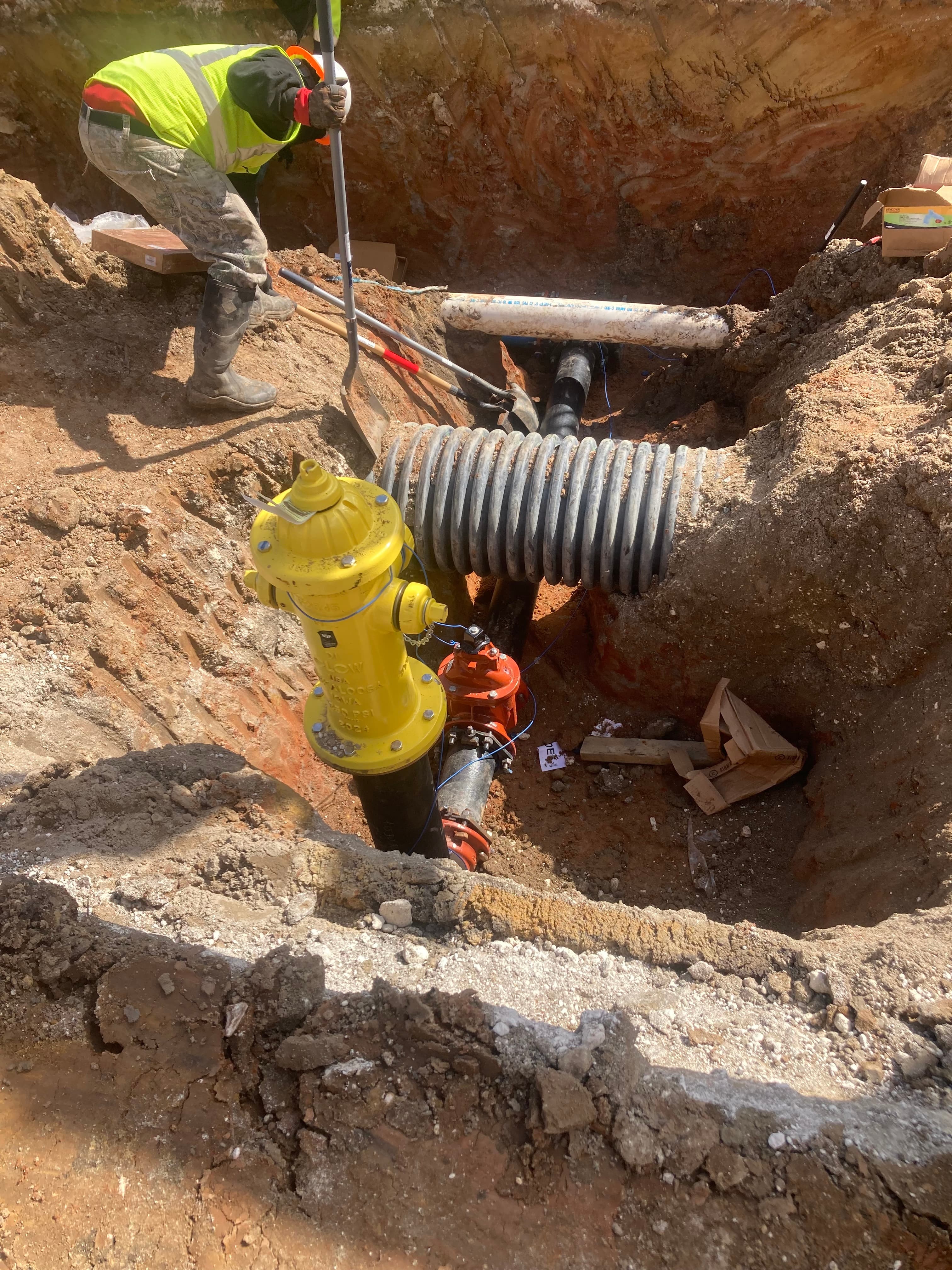
The process of removing earth to form a cavity, trench, or hole for utility installation. This includes precise digging, proper shoring, and adherence to safety regulations.
F
Force Main
A pressurized pipeline that moves wastewater or sewage from a lower to a higher elevation, typically using pumps in lift stations when gravity flow is not feasible.
Flow Monitoring
The measurement and recording of water or wastewater flow rates, velocities, and patterns within utility systems using specialized equipment and sensors.
See alsoInfiltrationFire Water Loop
A looped private fire service main encircling a building or campus so that fire flow can reach any hydrant or riser from two directions. Installed to NFPA 24, typically in large-diameter ductile iron pipe with restrained joints and thrust blocking.
G
Gravity Sewer
A pipeline that uses gravity to convey wastewater or stormwater from a higher to a lower elevation without the need for pumping equipment.
H
Hydrostatic Testing
A method of testing pipeline integrity by pressurizing the line with water to verify there are no leaks in the system before it goes into service.
See alsoQuality Control
I
Infiltration
The unintended entry of groundwater into sewer systems through defects such as pipe cracks, faulty joints, or deteriorated manholes.
See alsoInvert Elevation
The lowest point of the internal surface of a pipe or channel, crucial for determining flow direction and maintaining proper drainage slopes.
J
Joint Sealing
The process of creating watertight connections between pipe segments using specialized materials and techniques to prevent leakage and infiltration.
Jack and Bore
A trenchless crossing method in which a steel casing is jacked horizontally through the ground while an auger removes spoil ahead of it. The carrier pipe is then installed inside the casing.
K
Keyway Construction
A specialized construction technique where interlocking surfaces are created between concrete pours to ensure structural integrity and prevent differential settlement.
See also
L
Lift Station
A pumping facility that moves wastewater from a lower to a higher elevation when gravity flow is not feasible, typically consisting of a wet well, pumps, and controls.
See alsoForce Main
M
Manhole
A vertical shaft that provides access to underground utility systems for inspection, maintenance, and repair. Typically constructed of precast concrete with a cast iron frame and cover.
See alsoGravity SewerManhole Rehabilitation
The process of repairing and restoring deteriorated manholes to extend their service life and prevent infiltration using various materials and techniques.
Makeup Water
Water supplied to a cooling system to replace what is lost to evaporation, drift, and blowdown. On evaporatively cooled facilities it is delivered through a dedicated main sized independently of domestic demand.
N
Nitrogen Testing
A specialized method of pressure testing pipelines using nitrogen gas to detect leaks and verify system integrity, particularly useful for sensitive or dangerous materials.
O
Overflow Prevention
Systems and strategies implemented to prevent sewage or stormwater from exceeding system capacity and causing environmental or property damage.
See also
P
Pipe Bedding
The material placed beneath and around buried pipes to provide uniform support, proper grade, and protection from damage.
Pipe Bursting
A trenchless method of replacing buried pipelines where the existing pipe is fractured outward while a new pipe is drawn in to replace it.
See alsoTrenchless Technology
Q
Quality Control
Systematic processes and procedures used to ensure construction meets design specifications, industry standards, and regulatory requirements.
See also
R
Root Barrier
Physical barriers installed to prevent tree root intrusion into underground utilities, protecting infrastructure from damage and maintaining system integrity.
See also
S
Slope Stabilization
Techniques and methods used to prevent soil erosion and maintain the stability of excavated or natural slopes in utility construction.
See alsoExcavation
T
Thrust Restraint
Systems designed to counteract the forces created by pressurized water in pipelines, particularly at bends, tees, and dead ends.
Trenchless Technology
Construction methods that allow for the installation, replacement, or repair of underground utilities with minimal surface disruption and excavation.
U
Utility Locating
The process of identifying and marking the location of underground utilities before excavation to prevent damage and ensure worker safety.
See alsoExcavationUnderground Detention System
A subsurface stormwater storage structure — typically arched plastic chambers, large-diameter pipe, or precast vaults — that holds runoff and releases it at a controlled rate, allowing the land above to remain usable.
V
Vacuum Excavation
A non-destructive method of soil removal using high-pressure air or water combined with a powerful vacuum system, particularly useful around existing utilities.
W
Water Main
Primary pipelines in a water distribution system that transport treated water from treatment plants or storage facilities to service areas.
Wet Utilities
The underground systems that carry water: domestic and fire water distribution, sanitary sewer, storm drainage, and the pump stations that move them. The term distinguishes this scope from dry utilities, which carry electricity, gas, fiber, and telecom.
X
X-ray Inspection
Non-destructive testing method using radiography to examine pipe welds, joints, and structural components for defects or damage.
See alsoQuality Control
Y
Yard Piping
The network of pipes and connections within the boundaries of a treatment plant, pump station, or industrial facility.
See also
Z
Zone Valve
Control valves used to isolate specific areas or zones within a utility system for maintenance, pressure management, or emergency response.
See also
Popular services
- Water Main InstallationInstallation of municipal and private water distribution systems, ensuring reliable water supply for communities.
- Sanitary Sewer System ConstructionComprehensive sewer system solutions, from mainline installation to lateral connections, built to last.
- Storm Drainage & Retention ConstructionAdvanced stormwater management systems designed to protect property and meet environmental regulations.